Are Cheap Backlinks Safe? An Honest Risk Breakdown
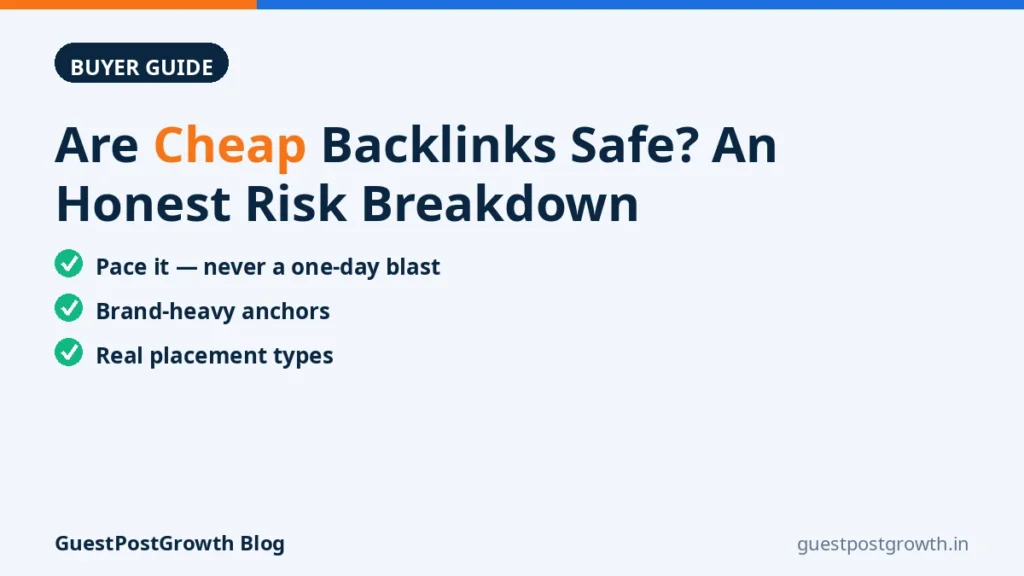
Are Cheap Backlinks Safe? It Depends on Three Things — Here They Are
Short answer: cheap backlinks are not automatically dangerous, and no paid backlink is completely safe. What decides the risk is rarely the price itself. It is three things you can actually check before ordering — how fast the links arrive, what anchor text they carry, and what kind of pages they sit on. A $35 foundation package built slowly, with brand-heavy anchors on ordinary platform pages, carries a modest, understood risk. A $35 package of “DA 60+” links blasted out overnight, anchored on your money keyword, carries a serious one. Same price tag, completely different risk. Below: the three factors in full, Google’s policy position, and the situations where the honest answer is “don’t buy this at all.”
The honest frame first: paid links sit in Google’s link-spam policy area
Google’s spam policies are not ambiguous. Buying or selling links that pass ranking credit, for the purpose of manipulating search results, is link spam. Paid links are permitted as advertising when they are qualified — marked rel="sponsored" or rel="nofollow" — precisely so they do not pass that credit. A followed link you paid for, placed to influence rankings, sits outside the policy whatever it cost: $35 or $350.
What enforcement looks like in practice is more graduated than the penalty stories suggest. Since the Penguin 4.0 update in 2016, Google’s systems mostly devalue manipulative links — they simply stop counting them — rather than demoting the site they point to. Manual actions for unnatural links do exist, typically where the pattern is egregious: large-scale link networks, obviously bought placements in bulk, anchor profiles no organic process would produce. Between those poles sits the commonest outcome of all for cheap links: nothing. The links are ignored, the money is gone, and the only damage is the budget.
So “safe” can never mean risk-free in this category, and any seller who tells you a followed paid link is “100% safe” or “penalty-proof” is misdescribing Google’s position — itself useful information about that seller. The realistic question is narrower: given that the baseline risk cannot be removed, how much do your choices add to it? That is where the three factors come in.
Risk factor 1: speed — a thousand links in a day vs the same thousand drip-fed
Links that arrive naturally arrive the way attention does: unevenly, spread over time, with quiet gaps in between. A thousand new links pointing at one small website inside 24 hours matches no organic process at all. It is the easiest pattern for a detection system — or a human reviewer — to spot, because it requires no judgement about link quality. The timeline alone tells the story.
Drip-feeding changes the shape of the same purchase. Spread over 12–15 days, the identical thousand links arrive as a modest campaign rather than an explosion. Speed also interacts with the site receiving the links: an established domain with years of link history absorbs a busy fortnight without it dominating the profile, while a three-month-old site is defined by it. This is why delivery time is a safety feature, not a convenience. A cheap listing that advertises “1,000 links in 24 hours” as a selling point has the risk equation exactly backwards — it is optimising for the seller’s throughput, and you carry the pattern it creates. Slower has one more practical benefit: you can stop. If day three’s sample looks wrong, a drip-fed order can be paused; a blast is already done.
Risk factor 2: anchors — why brand-heavy is the defensive default at volume
Anchor text is the other pattern that scales badly. A single exact-match anchor — “best travel insurance” — on one editorial page is unremarkable. Three hundred copies of it, arriving in the same fortnight, describe a purchase, not a reputation. Natural profiles are dominated by the boring forms: the brand name, the raw URL, the business name plus a city, and generic phrases like “visit website” or “read more”. Money keywords are a small minority, because most people who link to a business are naming it, not typing its target query.
Volume turns small percentages into large counts. Even a “mostly brand” mix across 1,000 links can hide eighty exact-match anchors if the proportions are not managed — which is why, at this scale, the anchor plan has to be written down and weighted deliberately: brand and URL forms as the clear majority, generics next, partial matches sparingly, and exact match rare enough to count on one hand. It is also why a listing that invites you to “submit up to 10 keywords” for a thousand-link package is handing you the rope: the feature that feels like control is the one that manufactures the footprint. How anchors interact with follow attributes is its own subject — our breakdown of dofollow vs nofollow backlinks covers what each side of a profile does. For a foundation package, the defensive test is simple: if the anchor list would look strange printed on a single page, it will look strange to an algorithm too.
Risk factor 3: placement type — platform foundation links vs hacked, injected or network links
The third factor is what the links physically are, and this is where “cheap” splits into two different products wearing the same label. The legitimate version of cheap is labour, not access. A person creates profiles on public platforms, saves bookmarks, posts shares, builds basic listings — work that takes minutes per placement, which is the only honest way a link can cost a few cents. The pages are real, the platforms are public, and the links are weak: they contribute breadth, brand footprint and discovery paths rather than ranking power. Links of modest value, on pages not pretending to be something else, are overwhelmingly ignored rather than punished.
The illegitimate version is inventory. Links injected into hacked websites without the owner’s knowledge. Placements across private blog networks — sites that exist only to sell links, dressed up with inflated authority metrics. Auto-approved comment and forum blasts across thousands of unrelated pages. This is the supply behind most “500 high-DA links, $49” offers, and a moment’s arithmetic exposes it: genuine editorial access to hundreds of strong, real websites cannot be bought for the price of a pizza. Network inventory is dangerous in ways foundation links are not. Network sites get identified and devalued in batches. Hacked placements vanish the day the owner cleans up — and while they last, they associate your site with a compromised one. If a cheap package’s price cannot be explained by cheap labour on public platforms, ask what it is actually buying. The answer decides the risk more than any other line in the listing.
The sites cheap links are genuinely wrong for
Brand-new domains with aggressive anchor demands
A new domain has no history to dilute anything. Its entire link profile is whatever arrives first, so a fast, keyword-anchored bulk package does not add to the site’s footprint — it is the footprint. If the site is weeks old and the plan is a thousand links carrying commercial anchors, the honest advice is to not run that order yet. Build the base slowly, let the first links be brand-named and few, and treat volume as something a site grows into. Our planning guide on how many backlinks a new website needs walks through a staged first-90-days order that keeps the early profile boring on purpose — boring being exactly what a young site’s profile should look like.
Sites expecting the package to rank a competitive keyword
The second wrong fit is an expectation problem rather than a safety one. Foundation links do not carry the strength to move a competitive commercial keyword, and no delivery schedule changes that. The risk appears in what happens next: the buyer, seeing no movement, concludes the dose was too small and buys more volume — stacking pattern on top of pattern while chasing an effect this product category cannot produce. If the real goal is ranking a money term, the budget belongs in editorial placements and stronger content, with a foundation package as background support at most. Buying it as the main strategy does not just waste the money; it tempts you into the escalation that creates genuine risk.
What “as safe as this product category gets” actually looks like in a listing
You cannot audit a seller’s intentions, but you can audit their listing. The lower-risk version of this product has recognisable fingerprints:
- The delivery window is printed, and it is a drip — days or weeks, not hours. Speed is treated as a risk to manage, not a feature to boast about.
- The anchor policy is stated up front: brand-heavy by default, with the mix described before you order rather than negotiated after you pay.
- The placement types are named in plain words — profiles, bookmarks, shares, listings — instead of vague promises about “high authority sites” that a few cents per link cannot buy.
- A full live-URL report is part of the offer, and a sample report is visible before you pay, so you can see exactly what a delivery looks like.
- Indexing expectations are honest: many foundation pages are crawled slowly and some are never indexed at all — a seller who explains how to check if a backlink is indexed is telling you how to audit them.
- The limits are printed on the sales page — what the package is for, what it cannot do, and no ranking promise anywhere. Our guide to what a backlink package should include spells out the full checklist.
Our own version of this product is 1,000 foundation links, drip-fed over 12–15 days with brand-heavy anchors — published with its limits on the page and a full report on delivery. That is the standard to hold any seller at this price point to, including us: if you buy at this price point, buy the version that prints its limits on the sales page — drip-fed delivery, brand-heavy anchors, full report, and no ranking promise anywhere.
Frequently asked questions
Can cheap backlinks cause a manual penalty?
It is possible, but it is not the most likely outcome. Manual actions for unnatural links are generally aimed at clear, large-scale manipulation — link networks, mass bought placements, aggressive anchor patterns. A modest foundation package is far more likely to be quietly ignored than manually penalised. The risk climbs with speed, exact-match anchors and network inventory, which is why those three factors matter more than the price.
Is there any completely safe way to buy backlinks?
No. Any followed link bought to influence rankings falls under Google’s link-spam policy, whatever the price or the seller’s promise. The genuinely policy-compliant paid links are advertising placements marked sponsored or nofollow — and those are compliant precisely because they do not pass ranking credit. Everything else is a managed risk, and the honest goal is keeping it small and understood.
How can I lower the risk if I buy a foundation package?
Slow the delivery down, keep anchors brand-heavy and written down in advance, stick to ordinary platform placements rather than network inventory, and start with a smaller order than you think you need. Then check the delivered report: open a sample of the URLs, confirm the anchors match the plan, and let weeks — not days — pass before judging the effect.
Does Google ignore low-quality links instead of penalising them?
Mostly, yes. Since Penguin 4.0 in 2016, the default response has been devaluation: links the system distrusts stop counting instead of dragging the target site down. Penalties still exist for patterns that look deliberately manipulative. The practical catch is that “ignored” is not a free pass — it usually means the money bought nothing, which is why the commonest cost of bad cheap links is a wasted budget, not a penalty notice.
What should I check in a cheap backlink listing before ordering?
Five things: a printed drip schedule rather than instant delivery; a stated anchor policy; placement types named in plain words; a full live-URL report with a sample you can inspect first; and the package’s limits printed on the page. If a listing also promises rankings or calls itself “100% safe”, treat those claims as the loudest warning on the page.
Ready to Buy Links the Honest Way?
Browse 1,500+ guest post sites with prices shown upfront, or compare guest post and niche edit packages in the store — every delivered editorial link is covered by our 12-month replacement promise.