Are Permanent Backlinks Really Permanent? The Honest Answer
The short answer is no. No backlink is permanent in the literal sense, because no seller controls the future of a website — including, in many cases, a website they own today. Blogs close. Domains lapse. Posts get edited, sites get sold, and hosting bills go unpaid. When any of that happens, a “lifetime” link dies along with everything else on the page. Anyone who guarantees you a link that lasts forever is promising you something that was never theirs to promise.
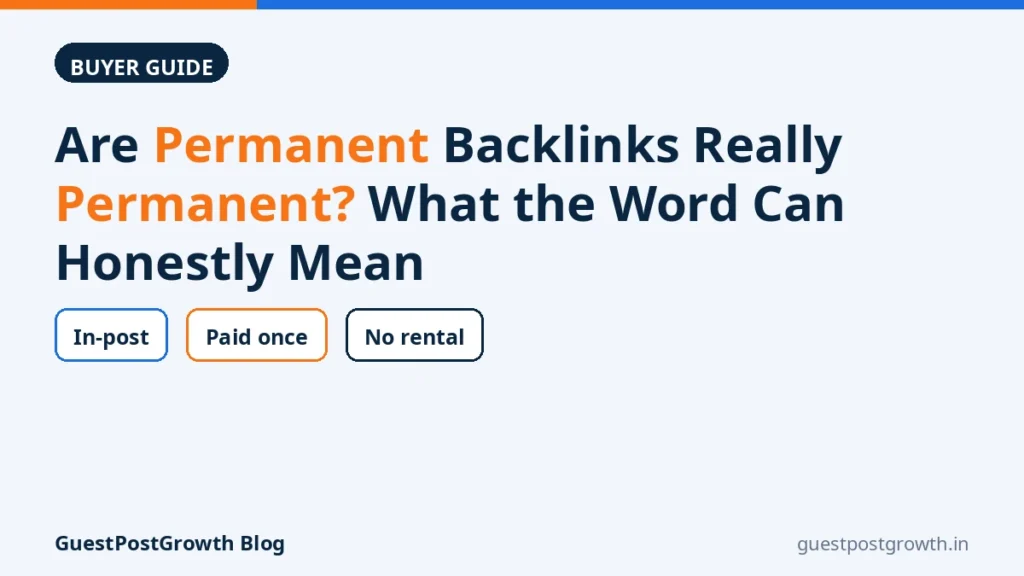
That does not make the word useless — it makes it a word that needs a definition. Used honestly, “permanent” describes the format of the deal, not a prediction: the link sits inside a published blog post rather than a rented sidebar slot, you pay once, and no monthly fee keeps it alive. On that definition, permanent backlinks are a real product you can verify on delivery day. On the “guaranteed forever” definition, they are a slogan. This page breaks down the difference.
The three things sellers mean by “permanent” (only one is honest)
Meaning one: the lifetime of something undefined. Read the small print behind many “lifetime backlinks” offers and the lifetime turns out to belong to the seller’s website, the seller’s company, or your customer account with them. If the company folds or the site is taken down, the “lifetime” has simply ended — by the seller’s own definition, they kept their promise. This is the version behind most lifetime backlinks complaints: the word sounded like forever and meant “until further notice.”
Meaning two: “we will never take it down.” Better, because it is at least a promise about the seller’s own behaviour. But it binds only that seller, only while they own the site and stay in business. It says nothing about a future owner cleaning house, a redesign deleting old posts, or the domain expiring. It is a statement of intent, not insurance.
Meaning three: a format. The link is placed inside the body of a published post, paid for in a single payment, with no rental clock running underneath it. It is expected to live exactly as long as the post it sits in — no more, and no less. This is the only version a buyer can check before paying and verify after delivery: the link is in the article text, and there is no subscription attached to it.
One more confusion sellers bundle into the pitch: permanent says nothing about follow status. A permanent link can still be nofollow, and a dofollow link can be rented by the month. Permanence is about duration; the follow attribute is a separate question, covered in our guide to dofollow vs nofollow backlinks. An offer advertising “permanent dofollow links” as though the two qualities guarantee each other is mixing two different axes to sound stronger than it is.
What actually ends a link’s life
Links rarely die because a seller planned to cheat you. They die because websites are mortal. These are the causes that account for nearly every vanished link we have ever audited — plus one quiet killer: a page can also fall out of Google’s index while the link still sits in its HTML, at which point the link has effectively ended even though it technically exists (our guide on how to check if a backlink is indexed covers how to spot that case).
The blog closes or changes owner
A blogger retires, sells the site, or lets the domain expire. The new owner — often someone who bought the site for its traffic or its domain name — prunes old sponsored content, rewrites posts, or takes the whole archive down. If the domain lapses entirely, your link ends up on a parked page or nowhere at all. No promise made by the previous owner binds the new one, which is precisely why “we will never remove it” is worth less than it sounds.
Pages get dropped in redesigns
Redesigns and platform migrations routinely change URL structures. Posts that are not redirected properly return 404s; old articles get merged, pruned as “thin content,” or dropped when categories are restructured. The site itself is alive and healthy — the specific page carrying your link simply no longer exists, or now redirects to the homepage, taking the link’s value with it. This is probably the single most common way in-post links die, and it happens on well-run sites, not just neglected ones.
The subscription stops (the rental case)
Sidebar, blogroll and homepage links are commonly rented: they stay live while a monthly payment continues and are removed the day it stops. Sold openly as rental, that is a legitimate model. But rented placements are sometimes marketed with permanent-sounding language — “lifetime placement, small monthly maintenance fee” — which is a contradiction. If anything about the deal recurs monthly, the link is rented, and its lifespan is exactly as long as your payments.
The defensible definition: format, not prophecy
Here is the definition we hold our own product to, stated on its page before anyone pays: permanent defined as a format: in-post, paid once. Twenty-five links placed inside published blog posts, one payment, no rental fee, and no expiry date set by us. That commits us to things we actually control — the placement format, the single charge, and the replacement cover described below. It does not commit us to a claim no one can make: that an independent blog will still exist in ten years.
That is the test to apply to any seller, us included. If the definition of “permanent” on the product page describes a format and a price structure, it can be verified and it means something. If it describes an outcome stretching into infinity, it is marketing — and the more absolute the wording, the less it tends to be worth.
What cover a seller CAN honestly offer
A seller cannot insure a link forever, but honest cover does exist. It just has edges, and the edges should be written down:
- A defined replacement window. Ours is 90 days: if a post carrying your link is removed within 90 days of delivery, we replace the placement free. Bounded, dated and checkable — that is what a real guarantee looks like.
- A full delivery report. Every live URL, the anchor text, the target page and the delivery date, so you can audit the links yourself on day one and re-check them later.
- Published terms. The cover should live in the store’s written refund policy, where it binds the seller, rather than in a chat message that can be forgotten.
What cover cannot do is just as important: it cannot resurrect a dead domain, bind a blog’s future owners, or insure a link for a decade. When a seller’s guarantee sounds unlimited, read its terms — you will usually find there are none, which is exactly how an unlimited promise is made affordable.
Questions to ask any “lifetime links” seller
- Whose lifetime? The site’s, your company’s, or mine? If the answer is vague, the guarantee is too.
- In-post or sidebar? Format is the real definition of permanence. Rented slots fail this test by design.
- What happens, in writing, if a post is removed in month two? Month thirteen? A dated replacement window is an honest answer; “don’t worry” is not.
- Do I get every live URL? You should be able to check each placement yourself — and see a sample report before ordering, so you know what evidence delivery includes.
- Is the price genuinely one-off? No renewal, no hosting contribution, no “maintenance” fee. Any recurring charge makes it a rental.
- Can I see old placements still live? Examples of posts delivered a year ago that are still up tell you more about a seller’s permanence than any promise on the sales page.
Vague answers to the first and third questions are the reliable tell. Sellers who have thought honestly about permanence answer both in one sentence each.
One last honesty point: permanence and Google’s rules
None of this changes Google’s position. Links bought to influence rankings fall under Google’s link-spam policies, and a link being permanent does not make it policy-proof — a temporary paid link and a permanent paid link are the same category in Google’s eyes. No seller can promise you rankings from any link, permanent or otherwise. Buy with that understood: judge the format, the cover and the reporting, and treat the ranking effect as something no honest person will guarantee you.
Frequently asked questions
Can any backlink be guaranteed forever?
No. A guarantee can only cover things the seller controls: the placement format, the price structure, and a defined replacement window. The future of a third-party website — its ownership, its hosting, its survival — is beyond any seller’s control, so any “forever” guarantee is, at best, a promise about the seller’s intentions.
Why do sellers say “lifetime” if it isn’t true?
Because it sells, and because it is rarely a deliberate lie about a specific fact — it is an undefined word doing heavy lifting. “Lifetime” quietly means the lifetime of the site, the company or the offer, none of which the buyer pictures when they read it. Sellers who define the term, or avoid it, are telling you something about how they handle every other claim.
What happens to my links if a blog shuts down?
They go with the site. If the domain expires or the archive is deleted, the links stop existing, and no replacement promise can bring back a website that no longer exists. This is the hard edge of every cover policy: replacement applies to removed placements on living sites, which is why the window and your own periodic checks matter.
Is a 90-day replacement a real guarantee?
Yes — a real, bounded one. It promises something specific (a free replacement placement), under a specific condition (a post removed within 90 days of delivery), that the seller can actually deliver. Its honesty is precisely its limit. Compare it with “lifetime guarantee” offers that publish no terms at all: the bounded promise is the one you can hold a seller to.
How can I check my old links are still live?
Start from your delivery report. Open each URL and confirm the page loads and your link is present in the article body with the agreed anchor — sampling the batch is a reasonable audit if the list is long. Re-check on a schedule, monthly or quarterly, and spot-check that key pages are still indexed, since a live-but-deindexed page passes nothing. Keep the report: without the original URLs and dates, there is nothing to audit against.
Buy the definition, not the slogan. Our permanent backlinks package states its format and its 90-day cover on the product page, before you pay — which is exactly where every seller’s definition should be.
Ready to Buy Links the Honest Way?
Browse 1,500+ guest post sites with prices shown upfront, or compare guest post and niche edit packages in the store — every delivered editorial link is covered by our 12-month replacement promise.