Dofollow vs Nofollow Backlinks: What Ratio Is Natural?
Dofollow vs Nofollow Backlinks — and the Ratio Question Behind Them
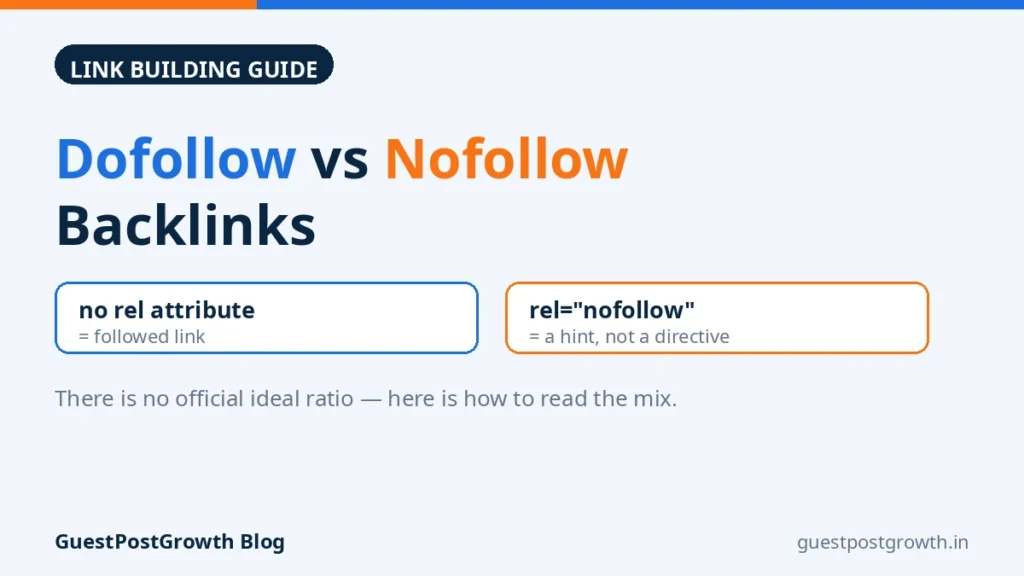
A dofollow backlink is an ordinary link with no qualifying rel attribute. There is no rel="dofollow" tag — “dofollow” is simply the industry’s name for the default state of a link. Search engines can follow it, and it can pass ranking credit from the linking page to yours. A nofollow backlink carries rel="nofollow", an attribute the linking site adds to say: we are pointing at this page, but we are not vouching for it. To a visitor both links look and behave identically; the difference exists only in the code, and only search engines read it.
And the ratio question, answered just as briefly: there is no official ideal ratio of dofollow to nofollow links. Google has never published one, and no study has produced a number that holds across industries. What real, organically grown link profiles share is not a percentage — it is a mixture. Profiles that contain only followed links are the unusual ones, because the everyday web — social posts, comments, forums, press coverage — generates nofollow links whether you plan for them or not. The rest of this page explains how each attribute works, what Google actually does with it, and how to think about the mix without chasing an invented number.
One place the ratio question turns practical is cheap bulk packages, which skew heavily nofollow. Before buying one, read our honest breakdown of whether cheap backlinks are safe — what the risks actually are, and where the line sits.
The four link attributes, side by side
Every backlink you will ever audit falls into one of four buckets, set by the rel attribute on the linking page. Two of them are old, and two arrived in 2019.
| Attribute | What the code looks like | What it tells Google | Where you typically see it |
|---|---|---|---|
| None (dofollow) | <a href="https://example.com"> | A normal link. It can be followed and can pass ranking credit. | Editorial mentions, resource pages, articles that cite you as a source |
rel="nofollow" | <a href="..." rel="nofollow"> | The linking site does not want to endorse the destination. | Links a site cannot vouch for; a general catch-all since 2005 |
rel="sponsored" | <a href="..." rel="sponsored"> | The link exists because of a paid or compensated arrangement. | Ads, paid placements, affiliate links, sponsored posts |
rel="ugc" | <a href="..." rel="ugc"> | The link was placed by a user, not by the site’s editors. | Blog comments, forum posts, user profiles |
The attributes can also be combined — rel="nofollow sponsored" is valid — and the followed/nofollow distinction says nothing by itself about quality. A dofollow link on an irrelevant, spam-built page is worth less than a nofollow link on a heavily read publication in your niche. Attribute is one dimension of a link; the relevance and authority of the page carrying it are others, which is why judging a link also involves questions like what counts as a good DA for a backlink.
What Google actually does with them: the hint model
Google introduced nofollow in 2005, together with Yahoo and Microsoft, as a weapon against comment spam. For fourteen years it worked as a directive: a nofollowed link was simply excluded from ranking calculations, full stop. That changed in September 2019, when Google announced two things at once — the new sponsored and ugc attributes, and a new way of reading all three: as hints rather than directives. From March 2020 the hint model was extended to crawling and indexing as well.
“Hint” means Google reserves the right to decide. It may still crawl a page it discovers through a nofollow link, use the link in its understanding of your site, or let some signal through when its other systems judge the link legitimate — and it may ignore it entirely. Nothing about that is a promise that nofollow links now pass full value; in practice their ranking effect remains muted. But the old mental model — nofollow equals invisible — has been outdated since 2020, and any guide still teaching it is working from a pre-2019 web.
Are nofollow links worthless?
No — and this is the second question buyers actually ask, usually after a seller has tried to make them feel their nofollow links are failures. A nofollow link is a real link on a real page, and everything except the direct ranking signal still works:
- Referral traffic. Readers do not check
relattributes before clicking. A nofollow link inside a widely read article or a busy forum thread sends visitors exactly like a followed one does. - Discovery. Under the hint model, Google may use a nofollow link as a crawl path. A new page linked from a popular platform can be found through it even if no followed link points there yet.
- Profile naturalness. Links accumulate on the open web in both forms. A profile with a natural nofollow share looks like what it usually is — a site people genuinely mention — while a profile engineered to contain none stands out for the wrong reason.
- Second-order links. Visibility compounds. Writers and editors find sources through links they encounter, and a nofollow mention on a read publication is how many later, followed editorial links begin.
None of this makes nofollow links equal to followed ones for ranking purposes — they are not, and anyone selling them as if they were is overselling. It makes them a normal, useful part of a profile rather than waste.
The ratio question: is there an ideal dofollow-to-nofollow ratio?
Search this question and you will be quoted confident numbers — 60/40, 70/30, 80/20 — often on the same results page, contradicting each other. Treat the confidence itself as the warning sign. No figure like that comes from Google, and none survives contact with real profiles, for three reasons.
Industry shapes the mix. A consumer brand discussed constantly on social platforms and forums accumulates large volumes of nofollow and ugc links by default — social networks, Wikipedia’s external links, most comment systems and many forums apply those attributes automatically. A B2B software company mentioned mainly in trade publications collects a different mix. Neither is doing anything wrong; their audiences simply link from different kinds of pages.
Profile size changes the arithmetic. A site with forty backlinks can see its “ratio” swing twenty points because one directory updated its link policy. Large, long-established profiles settle into whatever mix their history produced. Profile analyses reported by OutreachMonks and LinkResearchTools, for example, put even the Daily Mail at roughly 89% dofollow and Google’s own UK domain at around 88% — high, but never 100%, and these are among the most organically linked properties on the web. The observation worth taking from numbers like those is not the percentages themselves; it is that a mixed profile is what unforced linking looks like at every scale.
The ratio is an outcome, not a lever. It summarises where your links came from; it is not a setting you tune. The questions that actually predict whether a profile helps you are upstream of it: are the linking pages relevant, are they real sites with real readers, are the anchors varied, did the links arrive at a plausible pace? A profile can hit any textbook ratio with terrible links, and miss it with excellent ones.
Red flags at both extremes
Where the mix does earn a second look is at its edges. A profile that is effectively 100% dofollow — especially a young one, built quickly — displays a pattern unforced linking almost never produces, because earning links in the wild inevitably picks up nofollow ones along the way. That is the footprint sellers of “dofollow only” packages rarely mention. The opposite extreme is not a risk in the same way: a profile that is nearly all nofollow usually just means the site has platform and community presence but little editorial traction yet. It is a gap to build on, not a problem to fix — and converting it does not mean deleting or disavowing the nofollow links, which do their own work.
How to check your own mix
Start with what you can see for free. Google Search Console’s Links report shows the pages and sites linking to you, which tells you the shape and size of your profile — but it does not label each link’s rel attribute, so it cannot give you the dofollow/nofollow split on its own. For the attribute itself, check the source: open the linking page, inspect the link in your browser, and look at the anchor tag. No qualifying attribute means followed; nofollow, sponsored or ugc means it is not a plain followed link. Browser extensions automate the highlighting on a page, and crawlers such as Ahrefs or Screaming Frog report attributes across a whole profile at once.
One step sits before the ratio in importance: a link of either type only enters the picture once the page carrying it has been crawled. If you are auditing a recent campaign, first confirm the linking pages are actually in Google’s index — our companion guide on how to check if a backlink is indexed walks through that before you spend time classifying links that may not be visible to Google yet.
Planning a natural mix when you buy links
Buying links is where the ratio stops being an observation and becomes a design decision, because you are choosing the sources. Two honest principles cover most of it.
First, know which layer you are buying. If an audit shows your followed side is thin, a dedicated followed product is the direct fix — our dofollow backlinks package places 120 links and verifies every one of them as dofollow twice, at placement and again before the report is compiled, replacing any that fail. If your profile needs breadth rather than one attribute, a mixed build is the better-shaped purchase: the store’s 400-link SEO backlinks package spreads placements across profiles, Web 2.0 posts, bookmarks and contextual links, where the follow status simply follows each platform’s own settings — the way unforced profiles are made.
Second, judge the report, not the pitch. A delivery report should list every live URL with its anchor and its follow status recorded per link, so the mix you received is something you can verify rather than trust. Our published sample report shows that layout before you spend anything. And hold one boundary in mind: the attribute belongs to the platform, not the seller. A link verified dofollow at delivery can be changed later by the platform itself — a reputable seller states that limit upfront instead of guaranteeing a setting they do not control.
The honest part: paid links and Google’s policy
This needs saying plainly on a store that sells links. Google’s spam policies treat links bought or sold primarily to manipulate rankings as link spam, and the sponsored attribute exists precisely so paid placements can be disclosed. Nothing in this article changes that, and no seller can honestly promise that a purchased link is risk-free or that it will move a ranking — including us. What can be done honestly is the work described above: relevant placements, natural anchors, a plausible pace, a mix that does not pretend to be something it is not, and reporting you can check. Buyers who understand the policy landscape make better decisions inside it than buyers promised it does not apply to them.
Frequently asked questions
What is the ideal dofollow to nofollow ratio?
There is no official or universal one. Google has never published a target percentage, and real profiles vary by industry, size and history. Aim for a profile that mixes both types because its sources are genuinely varied — not for a number copied from a guide.
Do nofollow links help SEO at all?
Indirectly, yes. They pass little to no direct ranking credit, but they bring referral traffic, help pages get discovered, and make a link profile look like what it usually is. Since 2020 Google also treats the attribute as a hint, so it may weigh some nofollow links rather than discarding them automatically.
Is there a rel=”dofollow” attribute I can add?
No. Dofollow is not an attribute — it is the default state of a link with no qualifying rel value. Anyone describing a special dofollow tag is using shorthand, not describing real code.
Can a dofollow link become nofollow after it is placed?
Yes. The attribute is set by the linking site or its platform, and platforms change their policies. A link can be followed when delivered and read differently months later, which is why honest reporting records the status at delivery instead of guaranteeing it forever.
Should I disavow my nofollow links?
Almost certainly not. Nofollow links already tell Google you are not being endorsed, so there is nothing to distance yourself from. The disavow tool is meant for harmful followed links you cannot get removed — a different problem entirely.
How can I tell if one of my backlinks is dofollow or nofollow?
Open the linking page, inspect the link in your browser, and read the anchor tag: no rel attribute (or none of nofollow, sponsored, ugc) means followed. Extensions highlight attributes page-wide, and tools like Ahrefs or Screaming Frog report them across your whole profile.
The short version of everything above: followed links carry the ranking signal, nofollow links carry traffic, discovery and believability, and the healthiest profiles hold both — not because a ratio says so, but because real attention arrives in both forms. If your audit shows the followed side is the thin one, the 120-link dofollow package is built for exactly that gap, with every link verified dofollow before your report is sent — and if you are not sure which side of your profile needs work, send us the site first and we will tell you plainly.
Ready to Buy Links the Honest Way?
Browse 1,500+ guest post sites with prices shown upfront, or compare guest post and niche edit packages in the store — every delivered editorial link is covered by our 12-month replacement promise.