What Should a Backlink Package Include? Layers & Mix
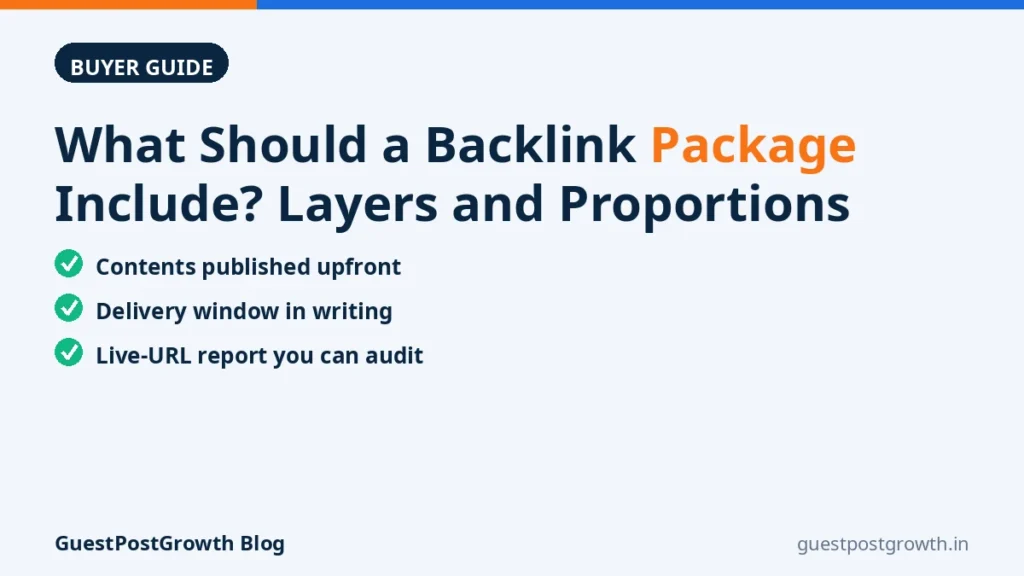
Ask what a backlink package should include, and most listings answer with a single number: 100 links, 500 links, 5,000 links. That number is close to meaningless on its own. A package worth buying includes four different layers of links in deliberate proportions — profile links, Web 2.0 posts, bookmarks and shares, and contextual links — with the exact mix published line by line before you pay, a delivery window measured in days or weeks rather than hours, and a report that lists every live URL at the end. The count is the last thing to look at, not the first.
Think of a package as a recipe rather than a pile. Websites that earn links naturally never accumulate one type of link over and over: they collect brand profiles, mentions inside articles, social traces and directory-style references in uneven proportions, because different people link for different reasons. A well-built package imitates that shape on purpose. This breakdown walks through each layer — what it does, what it cannot do, and what share of a mix it should reasonably hold.
Notice what a layered package deliberately leaves out: the giant bulk tier sold purely on link count. If you are comparing one of those against a layered package, our breakdown of whether cheap backlinks are safe shows what the low price usually leaves out.
The principle: a profile is mixed, so a package should be too
A backlink profile is the full set of links pointing at a site, and search engines read it as a whole. A profile made of a single link type — five hundred profiles, or five hundred comments, or five hundred posts on near-identical blogs — has a shape that no site produces by accident. It also concentrates your risk: if that one link type is discounted or the platform changes its rules, the entire spend goes with it.
Diversity in a package is therefore not decoration. Each layer does a different job. Some layers establish that your business exists and is consistent across the web. Some carry written content, which gives a link context. Some help new pages get discovered. And one layer — the smallest — does the heavy lifting that the others cannot. A seller who cannot explain what each part of the mix is for is selling volume, not a package.
Layer 1: profiles — the entity base
Profile backlinks come from accounts created in your business’s name on platforms across the web: your brand name, website URL and a short description, repeated consistently. Individually, these are weak links. Many sit on pages search engines treat cautiously, and plenty carry attributes that limit how much ranking weight they pass.
Their job is foundational rather than powerful. A consistent set of profiles tells search engines that the business is a real entity with a presence beyond its own website, and it gives a young site a base of branded, natural-looking references before anything stronger is built on top. Two things separate a proper profile layer from a token one: the profiles should carry your real business details rather than filler text, and the login credentials should be handed over with the report — a profile you cannot access is not an asset you own. We go deeper on what these links can and cannot do in our honest guide to whether profile backlinks are good for SEO.
Layer 2: Web 2.0 posts — content-carrying properties
Web 2.0 links come from posts published on hosted blogging and publishing platforms. Unlike a profile, which is mostly a name and a URL, a Web 2.0 post is a piece of written content — an article about a topic in your niche, with your link sitting inside the text. That surrounding content is what makes this layer a step up from profiles: the link has context, and the page can itself be discovered and indexed.
Quality here depends entirely on execution. A Web 2.0 layer built from unique, readable posts on varied platforms is a genuine content asset; the same layer built from spun text duplicated across accounts is filler wearing a better costume. Because the seller creates these properties, the accounts should again transfer to you — which is why this layer is also sold as a standalone Web 2.0 package for buyers who want the properties themselves, not just the links inside a mix.
Layer 3: bookmarks and shares — discovery and diversity
Social bookmarks and sharing placements are the lightest layer in any package. A bookmark link rarely passes meaningful ranking weight, and many are marked in ways that limit it further. Judged one by one, they look unimpressive — and sellers who charge premium prices for a package that is mostly bookmarks are relying on you not knowing that.
Their real job is support. Bookmarks and shares help crawlers find new pages faster, which matters when a package has just created fresh Web 2.0 posts and profiles that need discovering. They also widen the set of referring sources in the profile, which contributes to the mixed shape described above. In a healthy mix this layer is a minority share with a clear purpose — seasoning, not the meal.
Layer 4: contextual links — the layer closest to editorial weight
Contextual links sit inside the body of an article on a third-party page, surrounded by text that is relevant to your site. This is the placement type closest to the editorial links search engines value most, because the link appears where a writer would naturally put a reference. Of the four layers, this is the one that carries the most weight per link — and the hardest to produce honestly, since each placement needs real content and a real page to sit on.
When you evaluate this layer, check two things. First, that the links genuinely sit inside article text rather than in sidebars, footers or comment sections wearing a contextual label. Second, the follow status: a natural profile contains a blend, and our breakdown of dofollow vs nofollow backlinks explains why an all-one-way split in either direction deserves a second look. Fully editorial placements — guest posts and edits inside existing articles — are the premium end of this layer, and many sellers price them separately for exactly that reason.
Proportions: why the strongest layer is the smallest share
Once the layers make sense, the proportions should too. The strongest layer is the smallest share for the same reason it is the strongest: editorial-style placements are rare in any real profile. A site might be referenced in articles a handful of times while accumulating profiles, shares and listings by the dozen. A package that inverts that — claiming the large majority of its links are contextual, at a budget price — is almost always relabelling weaker links rather than delivering stronger ones.
The cost curve points the same way. Profiles and bookmarks can be produced efficiently; a contextual placement requires writing and placement work for every single link. Honest proportions are what that reality looks like when a seller publishes it instead of hiding behind a total.
A published example: reading a 400-link mix line by line
Our own package is the 400-link curated mix, published line by line on its product page: $119, delivered over 15 days. Read it against the layers above:
| Layer | Links | Share | Job in the mix |
|---|---|---|---|
| Profiles | 150 | 37.5% | Entity base and branded breadth |
| Web 2.0 posts | 110 | 27.5% | Content-carrying placements you end up owning |
| Bookmarks | 80 | 20% | Discovery for the new properties, plus source diversity |
| Contextual | 60 | 15% | The weight-bearing layer, kept deliberately scarce |
You do not have to buy this mix to use it. It works as a measuring stick: whatever package you are considering, ask whether its proportions — if the seller will even state them — look like this shape, or like a single layer with a large number attached.
What should never be in the mix
Three things disqualify a package outright, however attractive the headline count. Undisclosed network links: placements on a private blog network the seller refuses to identify. You cannot audit what you are not shown, and the report becomes a list of URLs you simply have to trust. Hacked placements: links injected into compromised websites. They vanish when the site is cleaned, they associate your business with a crime scene, and no legitimate seller needs them. Rented slots sold as permanent: sidebar and footer placements that disappear the month you stop paying are a rental, and there is nothing wrong with renting — unless it is sold to you as a permanent asset.
Two further warnings cost nothing to apply. Be wary of any package promising rankings: links influence rankings, but no seller controls them, and a guarantee is a sales technique rather than a deliverable. And be clear-eyed about the policy side — buying links primarily to manipulate rankings sits against Google’s link-spam policies, and paid placements carry that risk whatever the package contains. A mixed, transparently reported package is the most defensible way to buy; it is not a way to make the risk disappear, and any seller who claims otherwise is telling you what you want to hear.
Frequently asked questions
How many different link types should a package have?
At least three or four distinct types, covering different jobs: an entity layer such as profiles, a content layer such as Web 2.0 posts or articles, a discovery layer such as bookmarks, and a contextual layer. More types than that is not automatically better — five names for the same weak link type is still one layer.
Is a bigger package always better than a smaller curated one?
No. A large count can hide a poor mix, while a smaller package with published proportions tells you exactly what you are getting. The right size also depends on your site’s stage: a new domain absorbing thousands of links in a week looks nothing like natural growth, whatever the package contains.
Should a package include guest posts?
It can, but it does not have to. Guest posts are the premium end of the contextual layer — each one needs its own article and placement — so many sellers price them separately from mixed packages, which is reasonable when it is disclosed. What is not reasonable is a package whose “guest posts” turn out to be posts on the seller’s own Web 2.0 accounts; ask where the articles will actually appear.
What delivery time is reasonable for a few hundred links?
Days to weeks, not hours. A few hundred links appearing on the same day is a pace no real profile produces, and it usually signals automated creation. As a reference point, the 400-link mix described above is delivered over 15 days. Faster is not a feature here; a believable schedule is part of what you are paying for.
How do I compare two packages with different mixes?
Ignore the headline totals and compare layer by layer: write out each package’s proportions, compare the contextual share, check the delivery window, and ask what the final report contains — every live URL, or just a count. Then weigh what is published against what is vague. The package that survives being read line by line is usually the safer buy, even when its total is smaller.
The short version: compare any package against this breakdown — then compare it with ours, where the full 400-link mix is published on the product page before you pay. And before ordering from anyone, look at what a delivery report should actually show: our sample report is public, so you can hold every seller’s reporting to the same standard.
Ready to Buy Links the Honest Way?
Browse 1,500+ guest post sites with prices shown upfront, or compare guest post and niche edit packages in the store — every delivered editorial link is covered by our 12-month replacement promise.