What Makes a Backlink High Quality? The Buyer’s Checklist
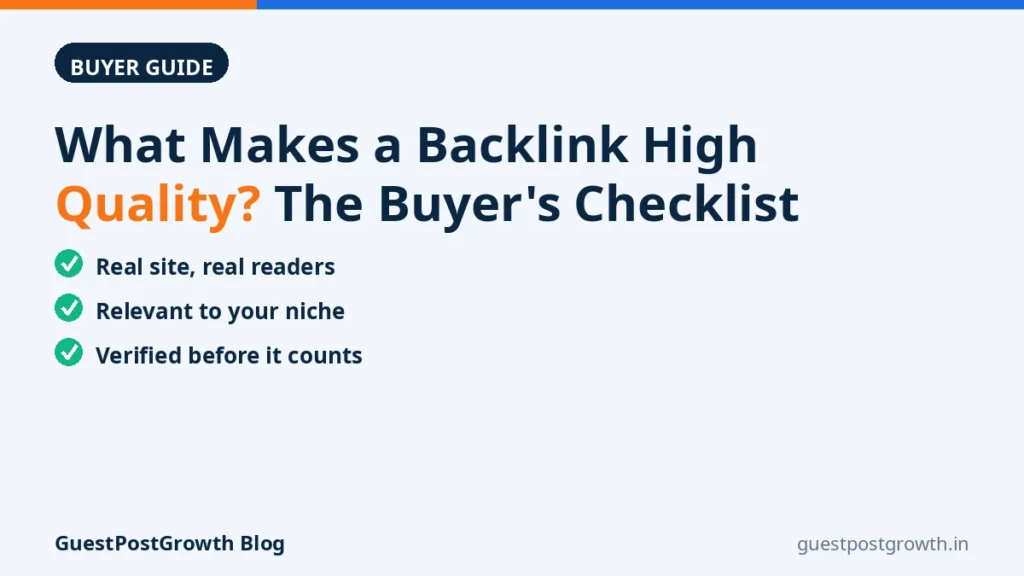
A high quality backlink is a link a sceptical human would read as a genuine recommendation. In practice it passes five checks: it sits on a real website with real content and a real audience; the site and the page are topically relevant to yours; the link lives inside genuine content rather than a sidebar, footer or links page; the page carrying it can actually be found and indexed by Google; and it was placed for an editorial reason, not sold to anyone with a budget. Domain Authority and Domain Rating come after all five — as a final sanity check, never as the definition of quality.
The order matters because most bad purchases happen the other way round. A buyer shops by metric, pays for a “DA 60” placement, and only later discovers the site is a content shell whose articles link out to casinos, plumbers and essay mills in rotation. This checklist runs the checks in the right order. Each criterion below comes with the verification steps, so you can score any site, sample URL or delivery report yourself in about five minutes — before you pay a seller, and again when the links arrive.
Criterion 1: The site is real — content, history and an audience
A quality link starts with a quality host. Real sites have a publishing history: articles spread over months or years, not forty posts uploaded in one week. They cover a recognisable subject, they have an identifiable owner or author, and somebody appears to read them — comments, social shares, or rankings for their own keywords. None of these signals is hard to check, and together they separate a publication from a shell built to sell links.
How to verify it yourself:
- Put the domain into the Wayback Machine (web.archive.org). Snapshots spread across years, with the site covering the same broad topic throughout, indicate a real publication. A domain that was a parked page or an unrelated business until recently is a dropped domain wearing a costume.
- Scroll the site’s own archive. Check the date of the oldest and newest posts, and whether the publishing rhythm looks human.
- Look for an About page and a contact identity. Anonymous sites with no owner, no authors and no history are hard to hold to any standard later.
- Glance at a traffic estimate in any SEO tool. Treat it as a rough “is anyone home?” signal, not a promise — estimates vary widely between tools. A site estimated at zero visitors month after month deserves a harder look at the other criteria.
Criterion 2: Topical relevance to your page
Relevance works at three levels: the site’s overall topic, the specific article’s topic, and the paragraph surrounding your link. A link to a plumbing company inside a home-improvement article passes all three. The same link inside a recipe post on a food blog — even a popular one — passes none of them, however strong the domain looks on paper. Search engines read the context around a link, and so do the readers you actually want.
How to verify it yourself: read the site’s ten most recent headlines. If your link would look at home among them, relevance is plausible; if you have to explain the connection, it is not there. Adjacent topics count — a DIY blog linking to a home-services company is a natural neighbourhood. Unrelated topics do not become related because the metric is high.
Criterion 3: The link sits inside genuine content
Where the link lives on the page is part of its quality. A high quality placement sits in the body of a real article, surrounded by text that is actually about the subject, with anchor text that reads like part of the sentence — a brand name, a descriptive phrase, occasionally a partial keyword match. It is one of a small number of outbound links in that article, and each one points somewhere a reader might genuinely go.
Footer links, sidebar blogrolls, author-bio links repeated across every post, and pages whose only job is to hold links all fail this criterion, whatever the domain’s metric says. Follow status plays a part here too: a followed link and a nofollow link do different jobs in a profile, and a buyer should know which one a placement carries — our comparison of dofollow vs nofollow backlinks explains what each attribute means before you judge a report.
How to verify it yourself: open a recent article on the site and find where a link like yours would sit. Read the paragraph around it. If the paragraph would make sense to a reader who never clicks, the placement is genuine; if the text exists only to hold the anchor, it is not.
Criterion 4: The page itself can be found and indexed
A link on a page Google never indexes passes nothing, because Google cannot count what it has not stored. Quality placements live on pages that are reachable through the site’s own navigation and internal links — not orphans published at a bare URL and linked from nowhere. The linking site itself should also be indexable: a site blocked in robots.txt or carrying a sitewide noindex is a strange place to buy visibility.
How to verify it yourself: search Google for the exact URL of the page carrying your link using the site: operator, and back it up with a quoted sentence from the page. Our step-by-step guide on how to check if a backlink is indexed walks through the methods and their limits. For a brand-new article, allow time before judging — but a seller’s older sample placements should already be indexed, and that is a fair thing to test before ordering.
Criterion 5: Editorial signals — not a links-for-sale page
The final criterion asks why the link exists. On an editorial site, outbound links serve the reader: sources, tools, further reading. On a links-for-sale operation, outbound links serve the seller, and the pattern is visible — article after article linking out to unrelated businesses on keyword-rich anchors, a public price list for dofollow posts, a “write for us” page whose real product is placements. A site that sells a link to everyone sells a footprint along with it, and footprints are what link penalties are built on.
How to verify it yourself:
- Open three recent articles and list their outbound links. Mostly editorial citations: good. Mostly commercial anchors for unrelated sites: walk away.
- Check whether the site advertises paid placements with prices and follow guarantees. Guest posting itself is a normal publishing practice; an open price list for guaranteed dofollow links is a different signal.
- Ask who else links there. If every article reads like an advert for a different industry, your link joins that pattern in Google’s view, not just in yours.
Where DA and DR fit — last, not first
None of this makes metrics useless. DA (Moz) and DR (Ahrefs) compress a domain’s link profile into a number you can compare quickly, and they are genuinely helpful for two jobs: filtering out the obviously weak or manipulated domains at the start of a search, and choosing between two sites that both pass the five criteria above. What a metric cannot tell you is anything about relevance, placement, indexation or editorial intent — which is most of what “quality” means. Our guide to what a good DA for backlinks looks like explains the bands, and why the only comparison that matters is against your own site and your competitors.
Metrics as a sanity check, not a shopping list
Use the number last, as a consistency test. Does this DA look plausible for a site of this age, with this much content and this audience? A two-year-old blog with thin content and a DA far above established publishers in its niche has usually bought or inherited that score, and inflated metrics collapse exactly when you rely on them. If a domain passes the five criteria and its metric is merely modest, the modest metric is not a reason to reject it. If it fails the criteria, no metric rescues it.
Scoring a sample link with the checklist
Here is the checklist working on a hypothetical offer. A seller proposes a link for a plumbing company and sends one sample: a two-year-old home-improvement blog. Scoring it takes five minutes:
| Criterion | What the check finds | Verdict |
|---|---|---|
| 1. Real site | Wayback Machine shows two years of snapshots on the same topic; posts appear most weeks; named author on the About page | Pass |
| 2. Relevance | Recent headlines cover renovations, heating and DIY repairs — a plumbing link fits the readership | Pass |
| 3. In genuine content | Sample article is a full repair guide; the link sits mid-article with a descriptive anchor, among three outbound links | Pass |
| 4. Findable and indexed | The blog’s recent articles appear in Google’s index; the new placement will need a re-check after a few weeks | Pass, with a follow-up |
| 5. Editorial signals | Outbound links in recent posts are mostly sources and product references; no public price list for posts | Pass |
| Metrics, last | DA in the low 30s — modest, but plausible for the site’s age and audience | Consistent |
Verdict: a modest-metric link worth buying, ahead of the same seller’s alternative offer — a DA 70 general-news shell whose recent articles link to essay mills and casinos. That second site wins on the shopping-list approach and fails criteria 1, 3 and 5 outright. When you shop, do the same pre-screening wherever listings show their data openly: our guest post sites marketplace shows per-domain metrics so you can shortlist, and then the five criteria decide. And when links are delivered, expect the report to let you re-run the checks per link — our sample report shows the format to demand: live URL, anchor, follow status and the domain’s metric, recorded at delivery.
The honest part: quality reduces risk, it does not erase it
One boundary belongs in any honest buyer’s checklist. Google’s link-spam policies treat links bought primarily to manipulate rankings as a violation, and no level of quality makes a paid link policy-proof or guarantees it will move a ranking. What the criteria above do is keep you on the defensible side of the practice — real sites, relevant placements, natural anchors, a plausible pace — and make sure the money buys links that would still make sense if a human reviewed them. Treat any seller who promises guaranteed rankings, or who refuses to show you sample placements to score, as failing the checklist before it starts.
Frequently asked questions
Is a DA 50 link always a quality link?
No. DA says nothing about relevance, placement or whether the linking page is indexed. A DA 50 link in an unrelated article on a site that sells placements to everyone can be worth less than a DA 25 link inside a relevant article on a blog with real readers. Run the five criteria first; use DA only as the final consistency check.
How can I verify a blog is real before ordering?
Check its history in the Wayback Machine, scroll its archive for a consistent publishing rhythm on one topic, look for a named owner or author, open recent articles to see whether outbound links are editorial, and search Google to confirm its pages are indexed. Five minutes of this catches most shells and dropped domains.
Does traffic matter more than DA?
Traffic — even a rough third-party estimate — shows a living audience, which DA alone cannot prove, since a score can be inflated by links nobody reads. Neither figure is sufficient by itself: a high-traffic site can still be irrelevant to your page. Relevance and genuine content come first, then audience, with metrics as the cross-check.
What is the single biggest quality signal?
That the link has an editorial reason to exist. If the article reads as though it was written for its readers and your link genuinely helps them — a source, a tool, a next step — the placement is quality. If the text exists only to carry the anchor, no metric or traffic figure changes what it is.
Can a low-DA link still be high quality?
Yes. A new or small niche site with real readers, publishing relevant content, can give you a genuinely good link long before its DA catches up — and natural link profiles are full of such sites. Low DA is a reason to run the other checks carefully, not an automatic rejection.
The short version
Real site, relevant topic, genuine content, an indexed page, an editorial reason — then, and only then, the metric. Score every sample and every delivered link in that order and the good backlink vs bad backlink question mostly answers itself. Our own quality package is built to be judged this way: these are hand-placed links on real niche blogs, chosen against this checklist. Every placement in our quality package is picked blog by blog against criteria like these — read the package spec, then hold us to it.
Ready to Buy Links the Honest Way?
Browse 1,500+ guest post sites with prices shown upfront, or compare guest post and niche edit packages in the store — every delivered editorial link is covered by our 12-month replacement promise.