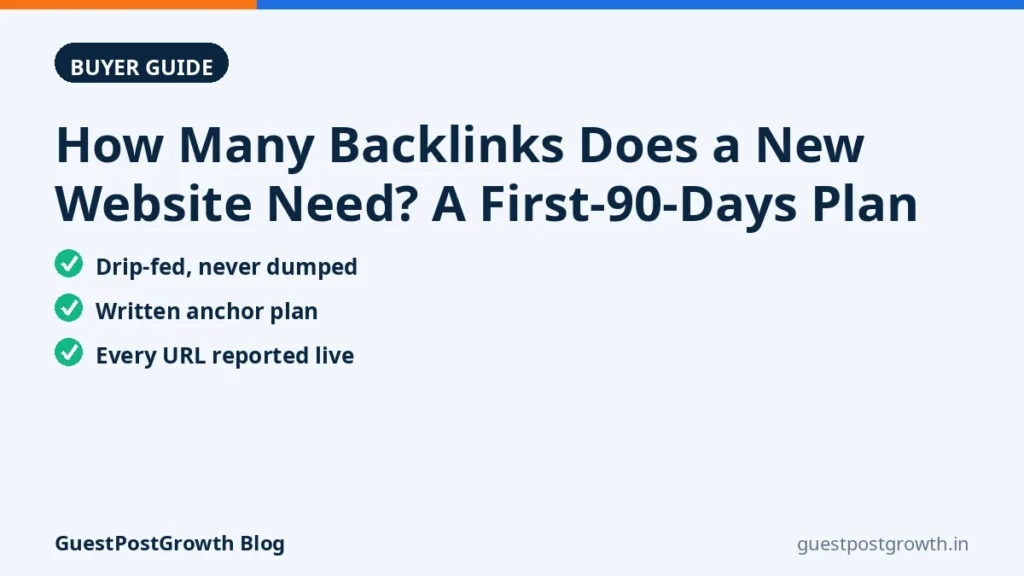
How Many Backlinks Does a New Website Need?
There is no fixed number of backlinks a new website needs — Google has never published one, and any seller who quotes you an exact figure (“every new site needs exactly 100 backlinks”) is inventing it. What actually decides whether early link building helps or hurts is not the total. It is the order you build links in, and the pace they arrive at.
Here is the short version of the plan this article walks through. In days 1–30, build the entity layer: profiles, directories and listings that prove the business is real. In days 31–60, add controlled volume — foundation links spread across weeks, with mostly branded anchors. In days 61–90, place your first editorial links on top of that base. By day 90, a new site in a low- or medium-competition niche usually has a profile that looks like a real business’s profile: dozens of referring domains across several link types, growing gradually. Whether your own total lands at the lower or higher end of that picture depends on your niche — which is where we start.
Why “how many” is the wrong first question
A backlink count treats every link as the same unit. They are not. An editorial link inside an article on a relevant site, a profile on a platform nobody reads, and a directory listing are three different things with three different weights — and Google also cares about how many different websites link to you (referring domains), not just how many links exist in total. A profile with 300 links from 12 domains is weaker, and stranger-looking, than a profile with 80 links from 60 domains. So before asking “how many”, ask two better questions: what should the first links be, and how fast should they arrive?
Age, niche and competition set the range
The honest reference point for “how many” is not a universal table — it is the pages already ranking for the searches you want to win. A local trades business competing against other local sites may need only a modest base of links to be competitive, because its rivals have modest bases too. A new site entering insurance, finance or legal keywords faces established domains with years of accumulated links, and no 90-day plan closes that gap; the first 90 days there are about building a credible base, not catching the leaders.
Age matters as well. A brand-new domain has no history, is crawled less often, and earns trust slowly. Links that would be unremarkable for a five-year-old site can look manufactured on a five-day-old one if they arrive in a rush. That is why this plan is phased over 90 days instead of front-loaded into the first week.
Diversity matters before volume
Real websites accumulate links of many types — profiles, listings, mentions, editorial links — with anchors that are mostly their brand name, their URL, or generic phrases. A new profile that is all one link type, or heavy with exact-match commercial anchors, stands out for the wrong reason. Build the mix first and let volume follow: brand anchors dominating, a natural share of nofollow links in the profile (which is normal — our breakdown of dofollow vs nofollow backlinks explains what each type does), and several different domains arriving each week rather than one type in one batch.
Days 1–30: entity and foundation layer
The first month’s job is not ranking. It is proof of existence. Create the profiles and listings a real business would have: social profiles, business directories, industry and local listings, and profiles on the platforms your customers actually use. These links are mostly nofollow or user-generated in type, which is fine — their job is to establish the entity, give Google consistent name and URL signals, and create the base that later links get added to.
In practice this layer is dozens of placements spread across the month, done steadily, alongside publishing your core pages. What profile links can and cannot do at this stage is covered honestly in our guide to whether profile backlinks are good for SEO — and if you are doing this layer yourself, our walkthrough on how to create profile backlinks shows the manual route. Point these links at your homepage and main service pages, using brand and URL anchors.
Days 31–60: controlled volume with brand-heavy anchors
With the entity layer in place, month two is where controlled volume belongs: foundation link types — more profiles, Web 2.0 posts, bookmarks and similar placements — added steadily across the whole month. Two things keep this phase sensible. First, the pace: links arriving week by week, in uneven daily amounts, resemble natural accumulation; the same links delivered in a single afternoon do not. Second, the anchors: at any real scale the anchor plan should be written down and brand-heavy by design — brand name, naked URL and generic phrases carrying most of the weight, with exact-match commercial anchors kept rare.
If you buy this layer instead of building it by hand, buy the schedule, not the blast: a 1,000-link foundation package with a written schedule spreads placements over a set period for exactly this reason. Whichever route you take, verify what actually arrived — spot-check that the links are live and starting to appear in Google’s index, using the methods in our guide to checking if a backlink is indexed.
Days 61–90: first editorial links on top of the base
By month three the site looks established enough for the links that carry the most weight: editorial placements — guest posts and in-content links on relevant, real websites. These should point at your best content and most important pages, not be scattered at random. For most small sites this phase is a handful of placements, not a flood: a few relevant editorial links on top of a broad foundation do more than another few hundred profiles would, and they look natural precisely because the base underneath them already exists.
This is also the point to start comparing your own profile against the specific pages you compete with. If the sites ranking for your target keywords have referring-domain counts in the low dozens, your 90-day base may already be in range, and the work shifts to content and patience. If they have hundreds of referring domains, you now know the real size of the gap — and that closing it is a longer campaign, not a bigger blast.
Numbers we would not cross with a new domain
These are working guardrails from planning builds like this — practical limits we apply ourselves, not thresholds Google publishes:
- No single-day spikes. If one day’s new links would dwarf the previous month’s total, the schedule is wrong. Growth should look like a staircase, not a cliff.
- Exact-match anchors stay a small minority. If most of your anchors are commercial keywords, stop and rebalance toward brand and URL anchors before adding any more links.
- Never one link type only. A profile that is 100% profiles (or 100% guest posts) is a footprint. If a new batch would push one type to dominate, diversify first.
- No links to pages that do not exist yet. Links pointing at thin placeholders or a “coming soon” page waste the placement and the money.
- Watch referring domains, not raw totals. Ten links from one domain count for far less than ten links from ten domains — plan for domain growth, not link growth.
When a new site should NOT buy 1,000 links yet
Volume is the wrong purchase in a few common situations. If your site has only a handful of thin pages, fix that first — links amplify what is already there, and there has to be something worth amplifying. If the domain is only days old with no entity presence at all, do phase one first; volume belongs in month two, not week one. And if your expectation is that 1,000 foundation links will, by themselves, rank you for competitive keywords, do not buy them under that expectation — foundation links build the base that editorial links stand on; they are not a ranking weapon on their own.
One policy note, stated plainly because we sell links: Google’s link spam policies treat links bought to manipulate rankings as a violation, and no seller — including us — can honestly promise rankings or guarantee that a purchase is risk-free. That is exactly why the pacing, anchor discipline and sequencing in this plan matter, and why a seller who will not show you a written schedule and a live-URL report is a seller to skip.
Frequently asked questions
Is 1,000 backlinks too many for a new website?
The total is not the problem — the timing is. A thousand foundation links landing in one day on a two-week-old domain looks manufactured, because it is. Spread over weeks with brand-heavy anchors, and built after the entity layer exists, the same volume is a defensible foundation choice. If your site is brand new, treat volume as a month-two decision, not a day-one purchase.
How many backlinks per day is safe for a new site?
There is no official safe number, and “safe” is the wrong frame. Natural growth for a new site is modest and uneven — some days no new links, some days a few. As a planning habit, keep daily additions small relative to the profile you already have, and let the rate grow gradually month by month instead of jumping in steps.
Should a new site buy backlinks at all, or wait?
Both routes work; they differ in time and effort, not in magic. Everything in the first two phases can be done manually for free — profiles and listings only cost hours. Buying the foundation layer buys those hours back. What we would not do is skip the sequence: bought or earned, entity links come before volume, and volume comes before editorial pushes.
What should come first — content or backlinks?
Content first — at least the core pages you actually want to rank. Links pointing at thin, missing or placeholder pages are wasted spend, and no editor will link to them anyway. Publish the essential pages, then start the 90-day sequence — and keep publishing during it, because new content gives later editorial links somewhere worthwhile to point.
How do I know if my link growth looks natural?
Check three things. Growth is gradual rather than spiky when you view new referring domains week by week. Anchors are mostly brand, URL and generic phrases rather than repeated commercial keywords. And the links come from many different domains and several types, not one batch of one kind. The Links report in Google Search Console shows this picture for your own site; a steady staircase is what you want to see.
The bottom line for a new website: stop counting links and start sequencing them — entity first, controlled volume second, editorial third, with anchors and pacing doing the safety work. If your site is in its first 90 days, the foundation layer is the place to start — see how our 1,000-link package spreads the build over 20 days instead of delivering it in one.
Ready to Buy Links the Honest Way?
Browse 1,500+ guest post sites with prices shown upfront, or compare guest post and niche edit packages in the store — every delivered editorial link is covered by our 12-month replacement promise.