What Is a Good DA for Backlinks?
There is no universal number. That is the honest answer to “what is a good DA for backlinks?” — and it is why the band tables you will find on most SEO blogs, including the one further down this page, only become useful once you add the piece they usually leave out: good compared to what?
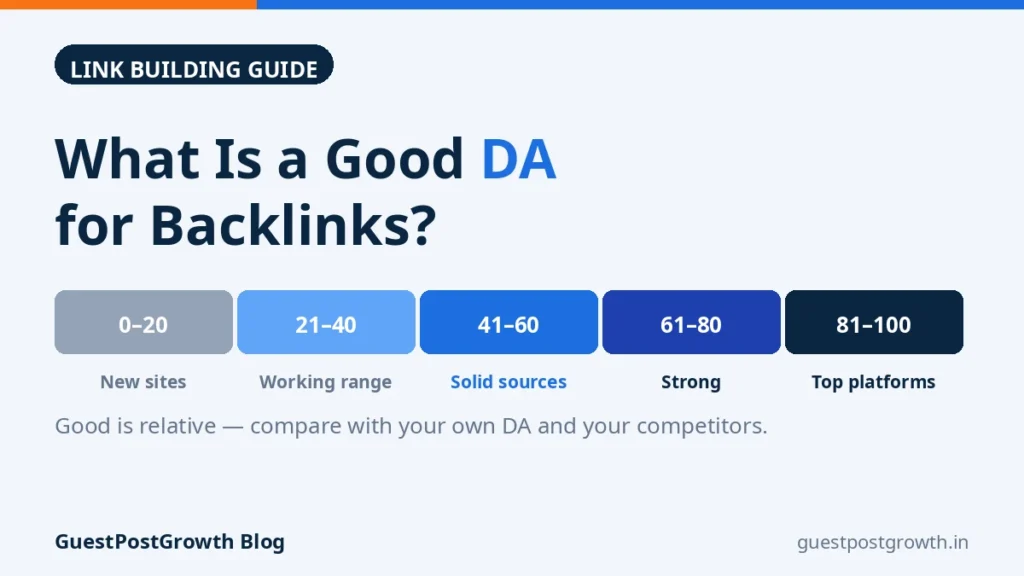
Here is the short version. Domain Authority (DA) is Moz’s 0–100 estimate of how strong a domain’s link profile is. As a rough guide, backlinks from DA 40+ domains are solid sources for most websites, and DA 60+ sources are strong. But the number only means something relative to your own site and the sites you compete with. A relevant DA 35 link can do more for a DA 15 website than a DA 70 link does for a DA 65 website, because the first link comes from a domain far stronger than the site receiving it, and the second barely moves the balance. The bands below explain the ranges; the sections after them explain how to actually use those ranges when you are choosing or buying links.
What DA actually measures
Domain Authority is a score developed by Moz. It is calculated with a machine-learning model over Moz’s own index of the web’s links — mainly the number of distinct domains linking to a site and the strength of those linking domains — and it is designed to predict how likely a domain is to rank in search results. Every domain starts at DA 1 and the scale runs to 100, where the very largest sites on the web sit.
Two properties of the score matter before you use it for any decision. First, the scale is not linear: growing from DA 20 to DA 30 is far easier than growing from DA 70 to DA 80, because the strongest domains hold enormous link profiles and each additional point demands disproportionately more. Second, DA is Moz’s estimate, built from Moz’s crawl of the web. Google does not use Domain Authority. It is not a Google metric, not a Google ranking factor, and not a number Google has ever confirmed it calculates in this form. DA is a third-party shorthand for link-profile strength — useful for comparing domains quickly, meaningless as a target in itself. Scores also shift when Moz updates its index or its model, so a small drop does not automatically mean you lost links.
DA bands explained — for link sources, not just your own site
Most band tables describe the website being scored. The table below flips the perspective: what each band typically means when the domain in question is a potential source of a backlink to your site. One warning before the table: Moz does not publish official cut-offs for a “good” or “bad” DA. The bands here are practitioner convention — the ranges most SEO guides use — interpreted for link evaluation. Treat them as orientation, not as thresholds handed down by Moz.
| DA band | What these domains usually are | What a link from this band is worth |
|---|---|---|
| 0–20 | New, small or local sites with thin link profiles | Acceptable as part of a natural mix if the site is real and relevant. On its own, a weak authority signal. |
| 21–40 | Typical small businesses, niche blogs and growing sites | The working range for most niches. A relevant editorial link here is genuinely useful, especially for newer sites. |
| 41–60 | Established sites with real, earned link profiles | Strong sources for most websites. This is where much genuine guest post inventory sits. |
| 61–80 | Large publishers, national brands, major platforms | Powerful links, but scarce and expensive as editorial placements. Be sceptical of bulk offers at this level. |
| 81–100 | Global platforms — Wikipedia, Google, major media and social networks | Nobody sells you an editorial link here. Links at this level are almost always profiles or subdomains — read the platform caveat below before valuing them. |
Read the table against your own position. If your site sits at DA 12, the whole 21–40 band is already a step up, and chasing 61–80 placements first is usually the wrong order of spending. If you compete against DA 55 websites, links from the 41–60 band are your realistic target, with a few placements above that as the stretch. The band a link falls in matters less than the distance between that band and yours.
“Good” compared to what? Your DA and your competitors’
DA is a comparative metric by design, but most buying advice treats it as an absolute one — “only buy DA 50+” — which is how budgets get wasted. Two comparisons turn the bands into an actual decision.
Compare against your own DA
A backlink is, in part, a transfer of relative strength. A link from a DA 40 domain pointing at your DA 15 site comes from a domain Moz rates far stronger than yours, and it pulls your profile upward. The same DA 40 link pointing at a DA 55 site adds little the site does not already have. A workable rule of thumb: links from domains at or above your own DA are the ones building your authority; links well below it mostly add breadth and diversity, which has its own place in a natural profile but should not be what you pay a premium for.
Compare against the pages you are trying to outrank
Before buying anything, check the DA of the domains currently ranking on page one for the keyword you want. If those sites cluster between DA 25 and DA 40, you do not need DA 80 links — you need a profile comparable to theirs, built mostly from relevant sources in the 20–50 range, and better pages. If the ranking sites sit at DA 60 and above, no quantity of DA 20 links closes that gap; you need editorial placements in the higher bands, which is a different product at a different price. Buying links without this check is buying blind, and it is the single most common reason link budgets produce nothing.
DA vs DR: same idea, different crawl
DR — Domain Rating — is Ahrefs’ equivalent score, and the two are routinely confused or deliberately mixed. Both rate a domain from 0 to 100 based on the strength of its backlink profile. But Moz and Ahrefs crawl the web separately, find different links, weight them differently and update on different schedules, so the same domain can legitimately read DA 38 in Moz and DR 51 in Ahrefs on the same day. Neither figure is “the true one”; they are two estimates of the same underlying thing.
The practical rules are simple. Compare domains within one scale only. When a seller’s report lists DR, verify it in Ahrefs; when it lists DA, verify it in Moz — and check the figure recorded is the domain’s score at delivery, since both scores drift over time. Our store sells both buying routes for exactly this reason: a high DR backlinks package built on DR 40+ domains for buyers who track their profile in Ahrefs, and DA-based packages for buyers working in Moz. What matters is that the number on your report is checkable in the tool it claims to come from.
The platform caveat: a domain’s DA is not your page’s strength
This is the most expensive misunderstanding in link buying. A profile on a DA 93 platform is a page on a subdomain, or a member path, of that platform. The DA 93 describes the platform’s root domain and its accumulated link profile — not your profile page, which starts life with no links of its own, its own thin content, and no guarantee of even being indexed. Search engines also treat many subdomains as largely separate sites. So when a listing advertises links “on DA 90+ sites,” the question to ask is: DA of the domain, or strength of the actual page my link will sit on?
We publish our own inventory data on exactly this point. Our profile backlinks sample lists 293 real platform domains with the DA of each domain shown. The strongest scores DA 98 — and only 44 of the 293 sit at DA 90 or above. The rest spread down through the middle and lower bands. That is what honest platform inventory actually looks like, and it is why the DA figure that matters in a delivery report is the per-domain score printed next to each of your links, not a headline number in a sales title. Profile links do have a legitimate job — entity presence, diversity, crawl discovery — and we work through it in full in are profile backlinks good for SEO. Borrowing a platform’s DA is not that job.
How many high-DA links does a site actually need?
No honest magic number exists, because the real question is how your profile compares with the specific pages you are competing against. A local business can outrank its market with a few dozen decent referring domains; a national affiliate site may need hundreds. Anyone who quotes you a universal figure — “every site needs 50 DA 50+ links” — has invented it. What can be said generally:
- Relevance beats raw DA. One editorial link inside an article on a relevant DA 35 site will usually contribute more than several unrelated DA 55 directory entries, because topical context is part of what makes a link credible.
- Referring domains beat raw link counts. Ten links from ten different domains build a broader profile than fifty links from two domains, and both Moz’s model and common sense reward the breadth.
- A link only counts once it is found. A high-DA placement on a page that never gets crawled passes nothing. Check that the pages carrying your links are actually being indexed — our walkthrough on how to check if a backlink is indexed covers the methods.
- Steady beats sudden. A profile that gains links month by month looks like a growing site. The same links arriving in one weekend look like a purchase, because they are one.
So the practical answer is: enough relevant links, from domains at or above your current level, to bring your profile in line with the sites already ranking — then reassess. For many small sites that is a smaller number than sellers suggest, spent on better sources.
Red flags when buying backlinks by DA
- The seller will not name domains. A single headline figure — “DA 50+ links!” — with no domain list you can inspect before or after delivery is marketing, not a metric.
- Bulk DA 80–90+ links at pocket-money prices. As the sample data above shows, genuine high-DA inventory is scarce. Hundreds of DA 90 domains do not exist as a cheap commodity, so offers built on them are selling profiles and subdomains dressed in the root domain’s score.
- DA propped up by spam. Check a candidate domain’s own backlinks and anchor text. A DA 60 domain linked from thousands of irrelevant, foreign-language or adult sites carries an inflated score — and linking to you from it transfers the risk, not the authority.
- Dropped domains in disguise. Expired domains are re-registered to inherit their DA, then filled with unrelated content. If a site’s current topic bears no relation to its history, the DA is a costume.
- DA quoted, follow status hidden. DA says nothing about whether a link passes equity or is marked nofollow. The two attributes describe different things, and our comparison of dofollow vs nofollow backlinks explains what each means for a purchase. A natural profile contains both — but you should know which you are paying for.
- Guaranteed DA increases for your site. Your DA moves when Moz recrawls and recalculates, relative to every other domain on the web. No link seller controls that, so a promised score by a promised date is a promise nobody can keep.
Frequently asked questions
Is DA a Google ranking factor?
No. Domain Authority is Moz’s metric, calculated from Moz’s link index, and Google does not use it. DA is useful as a comparison tool — a quick shorthand for how strong a domain’s link profile looks — but raising the number is not itself a strategy. The links that would raise it are what search engines actually respond to.
What DA should my own website aim for?
High enough to sit at or above the domains you genuinely compete with, and no more specific than that. Check the DA of the sites ranking for your target keywords: if they cluster at DA 30–45, a DA 40 site with relevant links is competitive, and chasing DA 70 mostly wastes budget. Review your score a few times a year rather than weekly — it moves slowly, and always relative to everyone else.
Is a DA 30 backlink worth getting?
Often, yes. If your site sits at DA 10–25, a relevant DA 30 link comes from a stronger domain than yours and is a real step up. It is worth little if it is irrelevant to your topic, sits on a page that never gets indexed, or is one of a thousand identical directory entries. Band, relevance and the quality of the actual page decide together.
Why do DA and DR give different scores for the same website?
Because the two tools crawl the web independently. Moz and Ahrefs discover different links, weight them differently and update on different schedules, so the same domain can be DA 38 and DR 51 at the same moment. Neither is wrong — they are different estimates of the same profile. Only ever compare domains within a single scale.
Can a domain’s DA be faked?
The score can be inflated, yes — through mass low-quality links, redirected dropped domains, or networks built to pump the metric rather than serve readers. The defences are unglamorous but effective: inspect the domain’s own linking sites and anchors, check whether it has real traffic and a coherent topic, and be suspicious when a high score arrives with no visible audience behind it.
Why did my DA drop even though I did not lose links?
Because DA is relative and periodically recalculated. When Moz updates its index or model, scores shift across the whole web; if competing domains gained links faster than you did, your number can fall while your own profile stands still. A small drop is normal noise. A large one is worth a link audit, starting with whether your important backlinks are still live and indexed.
So, what is a good DA for backlinks? The working answer
For most websites, treat DA 40+ sources as solid, DA 60+ as strong, and anything advertised above that with suspicion until you see the actual page your link will live on. Then adjust by the only comparison that matters: your own DA and the DA of the sites outranking you. If you are shopping the upper bands deliberately, our high DA backlinks package places 200 links on DA 50–100 domains for $80, drip-fed, with each domain’s DA recorded in your delivery report — the per-domain evidence this article argues you should demand from any seller, us included. And if your competitor check shows relevance is your real gap, the guest post marketplace on this site is the better first spend. Either way, buy against your competitors’ numbers, not against a generic table.
Ready to Buy Links the Honest Way?
Browse 1,500+ guest post sites with prices shown upfront, or compare guest post and niche edit packages in the store — every delivered editorial link is covered by our 12-month replacement promise.