DA vs PA: Why Page Authority Matters When You Buy Backlinks
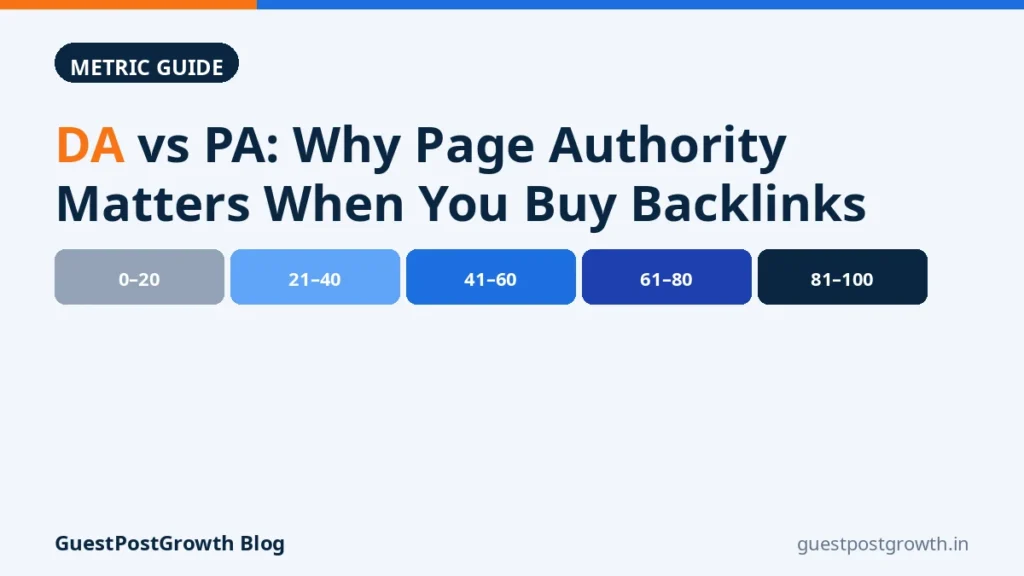
Domain Authority (DA) scores the whole domain; Page Authority (PA) scores the single page. Both are Moz metrics on a 1–100 scale, and both estimate ranking strength from links. When you buy a backlink, the distinction stops being academic: a seller quotes you the DA of their domain, but your link actually sits on one specific page — and that page has its own score, usually a much lower one. Checking both numbers is how you know what you are really paying for.
The short version: DA is the right filter for judging the overall strength of a site; PA is the right filter for judging the exact page your link will live on. And because a newly published page starts at PA 1 no matter how strong its domain is, PA explains why two links sold as “DA 70 placements” can be worth very different amounts.
The 30-second answer: DA is the domain, PA is the page
If you remember one line, make it this: DA screens the site; PA prices the page. And neither score is Google’s — both are Moz estimates, a point the FAQs return to.
| Domain Authority (DA) | Page Authority (PA) | |
|---|---|---|
| Scope | The entire domain | One exact URL |
| What it measures | The combined strength of every link pointing anywhere on the domain | The strength of the links pointing at that specific page |
| Starting point | A brand-new domain starts at DA 1 | A brand-new page starts at PA 1 |
| Best used for | Screening sites and comparing competitors | Judging the page your link will sit on |
How Moz calculates DA
Moz calculates DA with a machine-learning model trained against real search results. Its main raw material is the domain’s link profile: how many distinct websites link to it, how strong those linking sites are themselves, and how the links are distributed. A domain linked by hundreds of established sites scores high; a domain linked by almost nothing scores low.
Two properties matter when you use the score. First, the scale is not linear — climbing from DA 20 to DA 30 is far easier than from DA 70 to DA 80, because each point near the top requires a disproportionately stronger link profile. Second, DA is relative: your score can fall without your site losing a single link, simply because competing domains gained links faster or Moz updated its model. Treat small movements as weather, not verdicts — and only compare domains within the same metric, since Ahrefs’ Domain Rating comes from a different crawl.
How Moz calculates PA — and why a new page starts at PA 1
PA applies the same kind of model to a single URL. Instead of the domain’s whole link profile, it weighs the links pointing at that exact page — external backlinks first and foremost, with the internal links a page receives from the rest of its own site feeding into its link profile as well.
This produces the fact that matters most to link buyers: a newly published page starts at PA 1. On the day a guest post goes live, its PA is 1 whether the host site is DA 25 or DA 75, because the page has no links yet for Moz to count. That is not a penalty — the score updates as Moz recrawls, as the site links to the page internally, and if the page earns links of its own. But it does mean “DA 70 guest post” describes the building, not the room your link is in. Most guides are written for site owners improving their own pages, so this buyer-side consequence rarely gets stated plainly: the metric quoted in the listing (DA) and the metric describing your actual placement on day one (PA) are different numbers, and only one of them is in the headline.
A worked example: DA 70 homepage vs the DA 70 site’s inner page
Take an illustrative example — a trade publication with a DA of 70. Its homepage will typically carry a PA not far behind the domain score, because most external links a site earns point at its homepage. An established category page on the same site, fed by internal links and some external ones of its own, might sit in a middle band. And a blog post published on that site this morning sits at PA 1. Three pages, one domain, one DA figure on the invoice — and three very different placements. Where your link lands among them is what matters.
What this means for platform and profile placements
Profile and platform links are the extreme case. The profile page created for you is a brand-new URL on someone else’s domain: PA 1, often only lightly linked from inside the platform, and not always indexed at all. The number in the listing is the root domain’s DA, which your page borrows on paper only — so judge inventory domain by domain, not by a headline figure. Our published profile backlinks sample lists 293 platforms with the DA of each one: the strongest scores DA 98, yet only 44 of the 293 sit at DA 90 or above. That spread is what real platform lists look like — the per-domain figure in a delivery report is the one to check.
What this means for guest post placements
A guest post starts at PA 1 and builds from there. Whether it grows into a meaningful page is largely in the publisher’s hands: whether the post is linked from category pages, related articles and recent-post lists, and whether it stays live. So ask where the post will sit, what will link to it internally, and whether it stays published. There is also an alternative worth knowing: a niche edit places your link inside an existing article that has already accumulated its own PA — the core trade-off in the guest post vs niche edit decision. Neither route is automatically better; PA is the metric that shows you the difference.
When DA is the right filter and when PA is
Use DA when you are screening at scale. Comparing your site against competitors, working through a marketplace list of hundreds of domains, or setting a minimum bar for guest post inventory are all domain-level decisions, and DA is built for them. That is how our store’s High DA package is screened — platform backlinks on DA 50–100 domains, with the DA of every domain printed in the delivery report so the claim can be checked. Any threshold is relative, though: what is a good DA for backlinks depends on your site’s score and the domains you are trying to outrank, not on a universal cut-off.
Use PA when the decision is about a specific page. Choosing between placements, evaluating a niche edit target, or auditing a delivery report are page-level questions DA cannot answer. A practical rule: if a seller will name the exact page before you pay, check its PA; if the page does not exist yet, judge the domain’s DA and the publisher’s internal linking instead, and re-check the page’s PA a few weeks after delivery.
One honest boundary applies to both scores: neither changes Google’s position on paid links, which fall under its link-spam policies when bought to manipulate rankings — no metric makes a placement exempt. If you buy links, buy them on relevant pages, from sellers whose numbers you can verify.
How to check both scores before you buy
- Use Moz’s own tools first. Link Explorer returns DA for a domain and PA for an exact URL; a free Moz account includes a small monthly lookup allowance, enough for spot checks. The MozBar extension shows both scores as you browse.
- Cross-check third-party checkers against Moz. Most free DA/PA checkers draw on Moz’s data, so their figures should roughly match. If a seller’s quoted scores cannot be reproduced anywhere, ask why before paying.
- Check the exact page, not just the domain. For a placement on an existing page, paste that URL in and read its PA. For a new guest post, accept PA starts at 1 and check the growth signals instead: the domain’s DA, its internal linking to recent posts, and whether its recent articles get indexed — a page Google has never indexed passes nothing yet, so run through how to check if a backlink is indexed before judging the placement.
- Record both scores at delivery. DA and PA drift as Moz recrawls and remodels. What you were promised is the figure at delivery time, so that is the one to write down from the report.
One comparison this page does not cover: DA against Ahrefs’ rival score. If you are weighing the two big domain metrics against each other, our DA vs DR comparison covers where the numbers agree, where they split, and which one to trust for which job.
Frequently asked questions
Can a page have high PA on a low DA domain?
Yes. PA counts only the links pointing at that one page, so a single page that earns many strong links — a widely shared study, a free tool, a definitive guide — can reach a high PA while the rest of its domain stays thin and its DA stays low. Less common than the reverse, but real — so do not dismiss a page on DA alone.
Why is my page’s PA so much lower than the site’s DA?
Because the two scores count different link sets. DA aggregates every link pointing anywhere on the domain — the homepage, the popular guides, all of it. PA counts only the links pointing at your page’s exact URL, and most individual pages have few or none. New pages start at PA 1 by definition, and even older pages usually sit far below their domain’s DA until they earn links of their own.
Do PA and DA scores go up to 100?
Yes — both run from 1 to 100, with the very top of the scale belonging to the largest sites and pages on the web. And the scale is not linear: moving from 20 to 30 is far easier than moving from 70 to 80.
Which score does Google use — DA or PA?
Neither. DA and PA are Moz’s estimates, calculated from Moz’s own crawl of the web, and Google does not use them as ranking inputs. Their value is comparative — a consistent measuring stick for judging one domain or page against another before you spend money or effort.
Should I only buy links from high PA pages?
No. Restricting yourself to pages that already have high PA rules out every new guest post by definition, since fresh pages start at PA 1 — including good placements on strong, relevant sites. Judge the whole picture instead: the domain’s DA and relevance, whether the page is indexed, how it is linked internally, and whether it will stay live. Existing high-PA pages are one valid route (that is what a niche edit buys); a PA 1 page on the right domain is another.
If DA is the filter you shop by, our High DA package places 200 links across DA 50–100 platforms and reports the DA of every domain — check the package before you buy anywhere else.
Ready to Buy Links the Honest Way?
Browse 1,500+ guest post sites with prices shown upfront, or compare guest post and niche edit packages in the store — every delivered editorial link is covered by our 12-month replacement promise.